Table of Contents
An MBA in Supply Chain Management program is a smart pick for professionals already working in logistics, procurement, operations, sourcing, or supply chain. Those planning to shift their careers into supply chain management can also join the program for skill development and Resume enhancement.
Most businesses today operate across complex networks of suppliers, manufacturers, warehouses, distributors, and customers; hence, demand for supply chain management MBA professionals remains high. Hence, the course is a sure-shot key to career growth.
An MBA in Supply Chain Management combines business management with specialised knowledge of supply chain operations. It can help course participants understand how different parts of a supply chain system work together. TheMBA in supply chain program can also develop leadership and strategic decision-making skills.
But is thisSupply Chain Management MBA course worth pursuing in 2026? The answer of the query depends on several factors like your career goals, experience, and interest in business operations.
For professionals aspiring to managerial or leadership roles, thesupply chain management degree qualification can create a structured way to develop supply chain expertise within a stipulated time frame.
An MBA in Supply Chain Management: What is Scope of the Course?
A Course of MBA in Supply Chain Management is a postgraduate management program. It focuses on the planning, movement, sourcing, storage, and delivery of products and services within a supply chain network.
The MBA in Supply Chain Management course combines core MBA subjects with supply chain-related topics. Students can learn how organisations plan operations and manage resources while meeting customer and business requirements. Typical areas of MBA supply chain management study include:
- Supply Chain Planning & Procurement Management
- Logistics and Operations Management
- Strategic Inventory Management
- Warehouse Management & Strategic Sourcing
- Supplier Relationship Management
- Business Analytics & Supply Chain Risk Management
- International Business
- Financial Management
The program can be particularly useful for professionals who want to move beyond operational responsibilities and take on managerial positions.
Professionals therefore beyond operational knowledge, get to understand how supply chain decisions affect profitability, customer experience, risk, and long-term business strategy by learning this management course.
Is an MBA in Supply Chain Management Worth It in 2026?
For the right learner, an MBA in Supply Chain Management course can be a worthwhile investment. It is particularly relevant for professionals who want to combine management knowledge with supply chain expertise.
The worth of the supply chain management degree qualification depends on your career objective. Someone beginning a career in logistics may need practical experience alongside formal education.
An experienced supply chain functionality professional, however, may use a Supply Chain Management MBA to strengthen management capabilities and prepare for higher-level responsibilities. Consider these potential benefits:
- Develop Business Management Knowledge.
- Gain Specialised Supply Chain Expertise.
- Improve Strategic Decision-Making.
- Build Leadership Capabilities.
- Understand Financial and Operational Relationships.
- Prepare for Managerial Positions.
- Develop Cross-Functional Business Skills.
- Learn To Evaluate Supply Chain Risks.
The degree of MBA in Supply Chain Management is not a guarantee of career advancement although. Employers also value practical experience, analytical ability, communication skills, and knowledge of relevant technology.
Career Opportunities for an MBA in Supply Chain Management Professional
Supply chain management workflow covers several business functions. For obvious reasons, the range creates career opportunities across multiple domains like manufacturing, retail, e-commerce, logistics, pharmaceuticals, automotive, FMCG, technology, and other sectors.
Qualified supply chain professionals may try for significant and high-paying jobs based on their experience and specialisation. Potential career paths include:
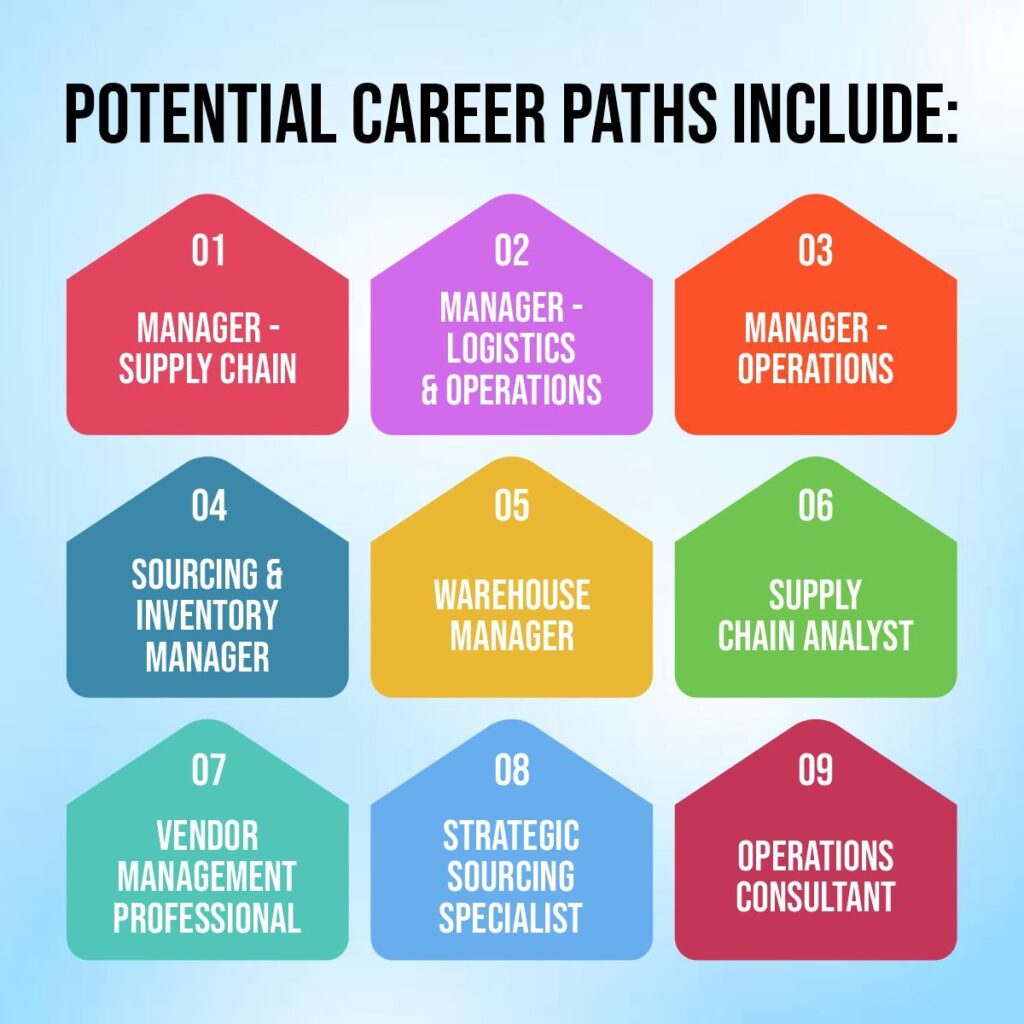
- Manager – Supply Chain
- Manager – Logistics & Operations
- Manager – Operations
- Sourcing & Inventory Manager
- Warehouse Manager
- Supply Chain Analyst
- Vendor Management Professional
- Strategic Sourcing Specialist
- Operations Consultant
With the support of relevant experience, professionals can move towards senior management positions. These roles often involve budgeting, strategic planning, supplier negotiations, team leadership, risk management, and performance improvement.
Skills You Can Develop Through the Program
One of the strongest reasons to consider an MBA in Supply Chain Management course is the opportunity to develop a combination of technical and managerial skills. Supply chain professionals must understand numbers, processes, people, suppliers, customers, and business objectives. A management program can help connect these areas.
Analytical Thinking: Supply chain decisions often involve large amounts of information. Professionals may analyse demand, inventory levels, transportation costs, supplier performance, and delivery times.An MBA can help learners in developing structured approaches to business analysis.
Strategic Decision-Making: Supply chain decisions can have long-term consequences. Choosing suppliers, designing distribution networks, and managing inventory all require strategic thinking.Students learn to evaluate business situations and consider financial and operational implications.
Leadership: Senior supply chain roles require people management. Professionals may coordinate procurement teams, warehouse staff, suppliers, logistics partners, and other departments. Leadership skills act supportive for career progression.
Negotiation: Supply Chain professionals regularly negotiate with suppliers and business partners. An expertise in the negotiation skills can influence costs, contract terms, quality, and delivery commitments.
Technology Awareness: Modern supply chains depend on digital systems. Professionals should understand how technology supports forecasting, inventory control, procurement, logistics, and reporting.
Read Also:-AI tools for Doctoral Research: Learn Smart strategies
How Technology Is Changing Supply Chain Careers
Technology is reshaping modern supply chain management. Businesses are using digital tools to collect information, automate processes, predict demand, and identify potential disruptions.
Artificial intelligence and machine learning can support demand forecasting and data analysis. Automation can reduce repetitive manual work in warehouses and distribution centres. Internet of Things devices can provide information about shipments, equipment, and inventory.
Professionals therefore need to become comfortable working with technology.
ASupply Chain Management MBA program can provide the business perspective needed to understand where technology can create value. However, learners should also develop practical digital skills outside the classroom. The list of important areas to explore include:
- Data Analytics
- Supply Chain Management Software
- Enterprise Resource Planning
- Artificial Intelligence
- Automation
- Demand Forecasting
- Digital Procurement
- Business Intelligence
Read Also:- DBA in Marketing: Is It Right for Your Career Goals?
MBA in Supply Chain Management vs a Traditional MBA
A traditional MBA provides broad management knowledge. It usually covers areas such as finance, marketing, human resources, operations, strategy, and business analytics.An MBA in Supply Chain Management adds a specialised focus on supply chain functions.
The right option depends on your career plans.
A specialised MBA like MBA supply chain management may be suitable if you already know that you want to work in:
- Logistics
- Procurement
- Operations
- Sourcing
- Inventory management
- Distribution
- Supply chain consulting
A general MBA may provide greater flexibility if you are still exploring different business functions.
Professionals should therefore evaluate the curriculum rather than choosing a program based only on its title.
Who Should Consider an MBA in Supply Chain Management?
The MBA in Supply Chain Management program may suit working professionals at different stages of their careers. However, it is particularly relevant to people who enjoy solving operational problems and working with business processes. You may consider this supply chain management degree if you:
- Work in a logistics or procurement department.
- Have experience in operations.
- Manage suppliers or vendors.
- Work in a manufacturing unit or in a distribution framework.
- Want to develop strategic business skills.
- Plan to build a career in supply chain consulting.
- Want specialised knowledge alongside an MBA qualification.
Working professionals can also consider online programs on MBA supply chain management if they need flexibility while continuing their full-time employment.
Read Also:- Global Business Strategy in Emerging Markets: Go with Flow
How to Choose the Right MBA Program?
The value of your MBA depends partly on the quality and relevance of the program. Before enrolling in an MBA in supply chain course, you should carefully review and validate the curriculum.
Look for subjects that match current business requirements. A strong program should provide a balance between management concepts and practical supply chain applications. Consider the following factors:
- Accreditation and Recognition
- Course Curriculum
- Faculty Profile
- Learning Format and Study Materials of the program
- Scope of Industry Exposure
- Case studies
- Business analytics training
- Technology-related subjects
- Assessment methods
- Career support
- Program flexibility
- Overall cost
Working professionals need to check whether the study schedule allows them to balance their work and education: if you are planning to join the program, do not forget to verify this balancing point.
Challenges to Consider Before Enrolling in an MBA in Supply Management Course
An MBA requires time, money, and sustained effort. It should therefore be treated as a long-term career investment rather than a quick route to promotion.

The program may involve assignments, examinations, group projects, case studies, presentations, and research work. Professionals studying while working must manage these responsibilities carefully.
There are also other ways to develop supply chain expertise. Short-term certifications, industry training, practical experience, and specialised courses may be suitable for professionals seeking specific skills.Before choosing an MBA, ask yourself:
- What Career Role Do I Want?
- Will The Degree Support That Goal?
- Do I Need an MBA Or Specialised Training?
- Can I Manage the Study Workload?
- Does The Curriculum Match My Career Plans?
- What Skills Do I Need to Develop?
The Future Scope of Supply Chain Management
Supply chain management is likely to remain an important business function as companies manage increasingly interconnected markets. Businesses need professionals who can balance efficiency, cost, customer expectations, technology, and risk.
Future supply chain professionals may need a broader skill set. They will need to understand business strategy while working with data and digital technologies.
Sustainability is also becoming an important consideration. Companies are examining sourcing practices, transportation emissions, packaging, waste, and supplier standards.
This means future managers may need to consider both financial performance and environmental and social responsibilities.
An MBA can provide a useful foundation for understanding these broader business issues.
Read Also:- Online Education for Working Professionals: Unlock Growth
Conclusion
A course on MBA in Supply Chain Management is worth pursuing in 2026 if your career goals align with the functionalities like supply chain, operations, procurement, logistics, or strategic management. The program can combine specialised knowledge with broader business and leadership skills.
However, the qualification needs to balance practical experience. Employers increasingly value professionals who can connect supply chain knowledge with data, technology, financial thinking, and business strategy.
Before enrolling, compare programs carefully and consider your career objectives, existing experience, learning preferences, and long-term plans.
Build Your Supply Chain Management Career with IIBM
If you are a working professional looking to strengthen your management knowledge and prepare for broader business responsibilities, an MBA in Supply Chain Management can be a strategic learning choice. Explore the management programs offered by IIBM Institute of Business Management and choose a learning path that supports your professional goals.
FAQs
1. What Is an MBA In Supply Chain Management?
An MBA in Supply Chain Management course covers multiple job responsibilities. Some of them are procurement, logistics, inventory management, operations, distribution, and supplier management, preparing professionals for supply chain leadership roles.
2. What Career Opportunities Are Available After an MBA In Supply Chain Management?
Qualified professionals may join work in different allied roles. Out of them a supply chain manager, logistics managers, procurement specialists, operations in-charge, inventory planners, sourcing managers, distribution executives across industries are some of the most common designations.
3. Is an MBA in Supply Chain Management suitable for working professionals?
Yes. Online and flexible MBA programs allow working professionals to develop supply chain expertise without leaving their current jobs or interrupting their careers.
4. What skills does an MBA in Supply Chain Management develop?
The program develops various skills in logistics planning, procurement, inventory control, supplier relations, cost management, data analysis, forecasting, negotiation, and operational decision-making.
5. Is an MBA in Supply Chain Management worth studying in 2026?
Yes, it is. The qualification can be a valuable choice for professionals, who are seeking careers in logistics, procurement, manufacturing, e-commerce, retail, and global supply chain operations.