
Table of Contents
AI tools for Doctoral Research are a game-changer in modern research methodology. The domain of PhD Reach is quite extensive. It may include literature reviews, data analysis, academic writing, referencing, and research planning. AI tools for PhD research can make the tasks simpler if you know how to use these tools.
Now, you may be wondering how these AI tools for PhD researchwork. There are multiple benefits of using these AI tools; however, in a quick review, you can count on their help with repetitive work and in helping researchers organize large amounts of information more efficiently.
If you believe that faster, more organized output is the only benefit of using AI tools for Doctoral Research, you may not have realized their full potential in supporting the research process. Before we name a few of the most used AI tools for Doctoral Research, let’s discuss the real-life benefits of using these AI tools.
1. Save Time During Literature Review
A literature review for doctoral research is a time-consuming task. It may take several weeks or even an entire month. Researchers often need to read and learn hundreds of papers before identifying the studies most relevant to the research question.
AI tools for doctoral researchcan make this process less time-consuming and more manageable. These AI tools for PhD research can help identify relevant papers, summarise research findings and reveal connections between different studies.
Instead of reading the documents from beginning to end during the initial screening stage, researchers can use AI tools to:
- Find papers related to specific research questions.
- Identify recurring themes across studies.
- Summarise lengthy research papers.
- Compare findings from different authors.
- Locate important references for further reading.
The researcher should still read the original papers before using their findings in a thesis. AI tools for doctoral students should be used as a shortlisting filter.
2. Discover Research Gaps More Efficiently
The research gap is the buzzword of a research program. In fact, finding the gap is the most important part of a doctoral research program. However, to identify the gap, a research scholar first needs to understand the research trajectory on the same or an allied topic.
But a comprehensive review of all previously published research papers is a Himalayan task. AI tools for doctoral studentswith their robotic efficiency can get the job done as easily as 1-2-3.
For example, a researcher studying digital transformation in business may use AI tools for doctoral researchto identify:
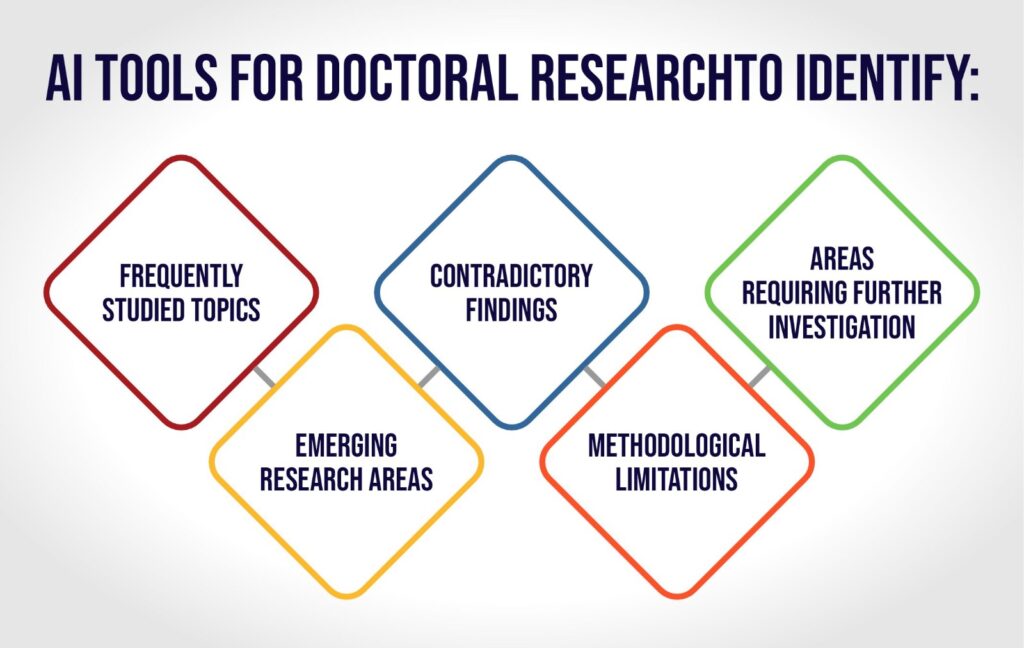
- Frequently studied topics.
- Emerging research areas.
- Contradictory findings.
- Methodological limitations.
- Areas requiring further investigation.
AI tools for doctoral research do not automatically determine whether a research gap is academically significant. That decision requires the researcher’s subject knowledge and critical judgment.
3. Improve Research Organisation
A Doctoral research program includes several workflows like managing numerous papers, notes, references, datasets and drafts. Poor organisation of these phases can waste valuable research time causing delay in program completion.
AI in doctoral researchcan help researchers organise information more systematically. They can support document classification, note organisation and reference management.
A structured research system can help scholars:
- Group papers according to themes.
- Organise research notes.
- Track important references.
- Retrieve information quickly.
- Maintain a clear record of research findings.
This becomes especially useful when a doctoral project continues for several years.
4. The Tools Help Understand Complex Academic Papers
Academic literature can contain complex terminology, statistical methods and theoretical frameworks. Researchers working outside their primary specialisation may find some papers particularly difficult to understand.
Tools of artificial intelligence in academic research can help explain difficult concepts in simpler language. A researcher can use them to clarify terminology, understand research methods, or break down complicated arguments.
For example, AI Tools can help explain:
- Concepts derived from statistical Data
- Research methods used so far.
- Different Theoretical models.
- Technical Terminology.
- Complex Academic Arguments.
The original source should remain the authority. AI explanations should be treated as learning assistance rather than evidence.
5. Strengthening the Flow of Academic Writing
Academic writing requires clarity, precision and logical organisation. Even researchers with strong subject knowledge may struggle to express complex ideas clearly.
AI writing assistant, for example,AI tools for PhD research can help identify grammatical errors, awkward sentences and unclear wording in a jiffy. They can also suggest ways to improve sentence structure.
Researchers can use AI tools for doctoral researchto improve the following features of a thesis:
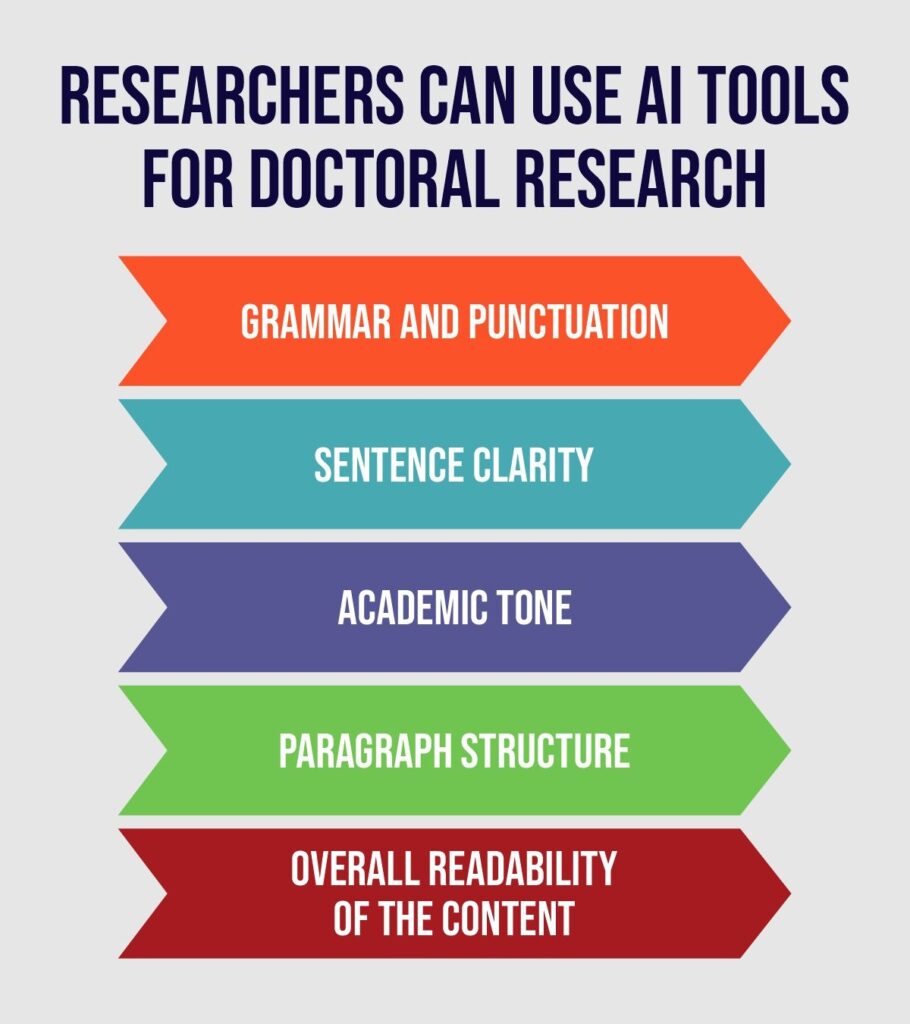
- Grammar and Punctuation.
- Sentence Clarity.
- Academic Tone.
- Paragraph Structure.
- Overall Readability of the content.
However, scholars should avoid allowing AI in doctoral research to generate substantial sections of a thesis without careful review. The final argument and intellectual contribution should remain the researcher’s own contribution.
Read Also:- PhD for Working Professionals:Build Research Skills
6. The Meticulous Use of AI tools Make Data Analysis More Efficient
Data analysis is another area where artificial intelligence in academic research can support doctoral researchers. Depending on the research discipline, AI-assisted tools can help with coding, data classification, pattern identification and preliminary analysis.
Researchers working with large datasets may use AI tools for doctoral research to assist with:
- Data Cleaning.
- Categorisation.
- Pattern Recognition.
- Statistical Analysis.
- Visualisation.
- Coding Assistance.
The researcher must verify the results carefully. An incorrect AI-generated analysis can affect the validity of the entire study.
Read Also:- PhD Research Topic: How to Choose the Right Research Area
7. Improve Research Question Development
A strong research question provides a clear direction for a doctoral project. AI tools can be useful during the early brainstorming stage of the project.
Researchers can provide their research area and ask AI to suggest possible research questions or perspectives. They can then evaluate these suggestions against existing literature and their research objectives.
AI tools for doctoral researchcan help researchers in considering the following aspects of a research program:
- Alternative Research Perspectives.
- Possible Variables.
- Different Theoretical Approaches.
- Potential Research Populations.
- Possible Methodological Approaches.
However, AI-tool’s ability may prove in efficient in this aspect. The final research question should emerge from an expert and human scholarly investigation. An AI-generated suggestion may not be adequate always.
Read Also:- Online Degrees in 2026: Advance Your Career Online
8. AI tools can help in Referencing and Citation Management
A doctoral thesis may contain hundreds of references. Managing them manually can become difficult and it may take lots of time.
Reference management tools can help researchers organise sources and create citations in required academic styles.
TheseAI in doctoral research tools can perform the following tasks with robotic efficiency:
- Storing References.
- Organising Sources.
- Generating Citations.
- Creating Bibliographies.
- Switching Between Referencing Styles.
Researchers should always verify citation details. AI systems can sometimes create inaccurate or non-existent references.
9. AI-tools Help Researchers Handle Large Volumes of Information
One major benefit of AI tools for doctoral research is its ability to process large amounts of information quickly with robotic data management.
A doctoral researcher may have to work through hundreds of academic papers, reports, interview transcripts or other documents. AI tools for PhD research can assist with initial classification and summarisation.
These AI tools turn productive in the research programs with:
- Important Themes.
- Repeated Concepts.
- Similar Arguments.
- Contradictory Findings.
- Relevant Sections for Deeper Reading.
This approach can make the research workflow more manageable without reducing the need for detailed scholarly reading.
10. 10. AI tools can Improve Research Productivity
Doctoral research involves many repetitive tasks. AI can reduce the time spent on some of them.
For example, researchers may use AI to assist with summarising notes, organising ideas, checking language or generating preliminary outlines.
Read Also:- Common Mistakes PhD Students Make: A Success Guide
This creates more time for activities that require human judgment, such as:
- Developing Arguments.
- Evaluating Evidence.
- Conducting Original Research.
- Interpreting Findings.
- Building Theoretical Contributions.
- Writing the Final Thesis.
The goal should not be to use AI tools for doctoral research for every research task. The goal is to use it where it provides genuine value and authentic output.
11. Learn Smarter, Not Just Faster
Using AI effectively in doctoral research requires more than knowing which tools are available. Researchers need to understand when and how to use them.
A smart AI strategy includes three stages:
- Use AI to explore: Identify literature, concepts, research directions, and possible questions.
- Use AI to assist with writing, organisation, coding, data processing, and research management.
- Use human judgment to verify: Check sources, validate findings, evaluate arguments and make research decisions.
This approach keeps the researcher at the centre of the doctoral process.
12. Maintain Academic Integrity
The benefits of AI tools come with responsibilities. Doctoral scholars must understand their university’s policies on AI use, authorship, disclosure and academic integrity.
Researchers should never assume that AI-generated information is accurate. AI systems can produce incorrect facts, misleading interpretations and fabricated citations.

However, before using AI-generated results, researchers should perform the following steps:
- Verify information against the original sources.
- Check every citation for accuracy.
- Avoid submitting AI-generated work for original scholarship.
- Maintain accurate research records.
Read Also:- Online Degrees in 2026: Advance Your Career Online
AI Research Tools and Their Main
| ChatGPT for Research Ideas & Academic Support | Brainstorming, research questions, outlines, explanations and editing. |
| Elicit for Literature Review | Finding papers, extracting information, comparing studies and identifying research gaps. |
| Consensus for Evidence-Based Research | Finding research-backed answers, supporting evidence and contrasting findings. |
| Scite for Citation Analysis | Checking citations, citation context, supporting evidence and contrasting studies. |
| Semantic Scholar for Paper Discovery | Finding academic papers, related research, authors and influential studies. |
| Connected Papers for Literature Mapping | Visualising research connections, related papers and key studies. |
| Grammarly for Academic Writing | Improving grammar, clarity, spelling, punctuation and readability. |
| QuillBot for Paraphrasing & Editing | Rephrasing text, improving flow, simplifying language and reducing repetition. |
| NotebookLM for Research Material Analysis | Summarising, comparing and questioning researcher-provided documents. |
| Zotero for Reference Management | Collecting sources, organising references, inserting citations and creating bibliographies. |
How AI Can Make Doctoral Research More Efficient
The biggest advantage of AI tools for doctoral researchis not simply speed. Their core value comes from the need to reduce repetitive tasks and help researchers work more organised.
For example, a doctoral researcher may use one tool to discover literature, another to analyse citation patterns, another to manage references, and another to edit the final draft.
A practical research workflow may look like this:
| Research question → |
| Literature discovery → |
| Source evaluation → |
| Reference management → |
| Data collection → |
| Analysis → Writing → Editing → Final verification |
AI Research tools can provide robotic support in the several stages of this process. However, the researcher remains responsible for the final academic output in the research program, and ideally it is expected to be a human process.
Conclusion
AI tools for doctoral researchcan make the research journey more organised, efficient and manageable. They can support literature reviews, research gap identification, academic writing, data analysis, referencing and information management.
But AI is not a substitute for doctoral-level thinking. The researcher’s ability to question evidence, interpret findings and develop an original contribution remains central.
The smartest strategy is therefore not to let AI tools for doctoral students do the research finally at all. It is to use AI to reduce repetitive work and create more time for meaningful scholarly thinking.
Take Your Research Skills Further
Doctoral research requires more than a research topic. It demands analytical thinking, academic discipline, research methodology, and the ability of the research scholar to apply knowledge to real-world problems.
IIBM Institute of Business Management offers programs designed for learners seeking higher-level knowledge and professional growth.
FAQs
1. How can AI tools help doctoral researchers?
AI tools can perform several research tasks. Some of them support literature searches, research planning, data analysis, academic writing, reference management, and document organization, helping researchers save time.
2. Which AI tools are useful for a doctoral literature review?
AI Tools such as Elicit, Consensus, Semantic Scholar, Scite, and Connected Papers can help researchers discover papers, analyse studies, and explore valid research connections.
3. Can AI tools help identify research gaps?
Yes, it is possible to identify research gaps with the assistance of AI tools. AI tools can analyse existing literature, highlight recurring themes, compare findings, and reveal under-researched areas that may require further academic investigation. However, the results should be verified by human examination.
4. Is it safe to use AI tools for academic writing?
AI tools can assist with editing, clarity and structure, but cannot guarantee about the 100% accuracy of the outputs. It is always recommended that researchers should verify information, avoid fabricated citations and follow their institution’s academic integrity guidelines.
5. Is it possible for doctoral researchers to use AI but maintaining academic integrity?
Yes, it is possible. Researchers should use artificial intelligence as a supportive tool and with responsibility to cross check every output. They can use the Tools to verify generated information, cite sources, protect research data, and follow institutional policies governing responsible AI use.