Table of Contents
An evaluation between MBA vs Executive MBA (EMBA) is all about advanced career choice. Both are MBA or business management courses and both professional programs focus on business knowledge, leadership, management, and professional growth. However, both MBA and Executive MBA are set for different types of learners.so that is result of comparing MBA vs EMBA?
An MBA program is generally suitable for fresh graduates and entry-level professionals. The main purpose of an MBA is to create a steady foundation for a career in management domain.
An Executive MBA (EMBA) is ideal for working professionals, junior-managers, and entrepreneurs. Choosing between an MBA and an EMBA depends on your career stage, work experience, professional objectives, and learning needs.
The Traditional MBA: An Outline Concept
A Master of Business Administration, or MBA, is a postgraduate management program that provides broad knowledge of different business functions.
Many MBA programs count on the applicants’ professional background including service experiences. Many of these programs require clearance from standardized exams like the Graduate Management Admission Test (GMAT) or Graduate Record Examination (GRE). However, MBA programs are available with test waivers or test-optional admissions range.
A student of traditional MBA learns about areas like:
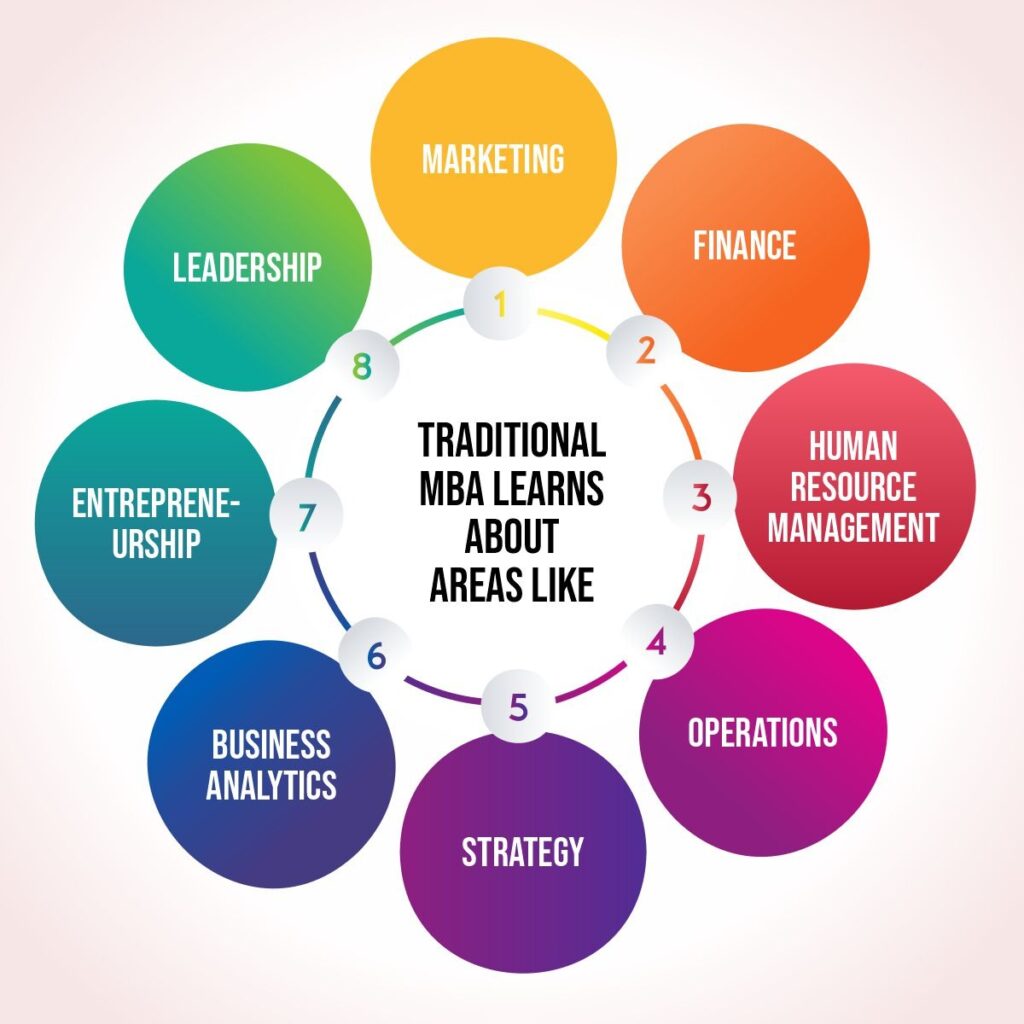
- Marketing
- Finance
- Human resource management
- Operations
- Strategy
- Business analytics
- Entrepreneurship
- Leadership
A traditional MBA is mostly suitable for people who want to avail management roles or explore a new career direction in managerial range. The MBA course usually focuses on developing fundamental business knowledge. After completion of the course, students learn how organisations operate and how managers take strategic decisions.
An MBA is strongly recommended for:
- Fresh graduates
- Entry-career professionals
- Professionals seeking career growth
- Individuals planning a career switch
- Aspiring entrepreneurs
- Candidates looking for management positions
Traditional MBA is a regular learning experience: It includes classroom discussions, projects, case studies, presentations, and group assignments.
What Is an Executive MBA?
An Executive MBA (EMBA) course suits experienced working professionals, who are planning to upgrade their leadership skill. Unlike a traditional MBA, an Executive MBA generally focuses more strongly on leadership, strategic decision-making, and senior-level management challenges.
EMBA students generally show significantly more professional and managerial experience than traditional MBA students. According to the survey of the Executive MBA Council in the year 2025, EMBA students are in an average 38-40 years old, with average 15 years of professional experience and 6.5-9.1 years of management experience.
An Executive MBA may be suitable for:
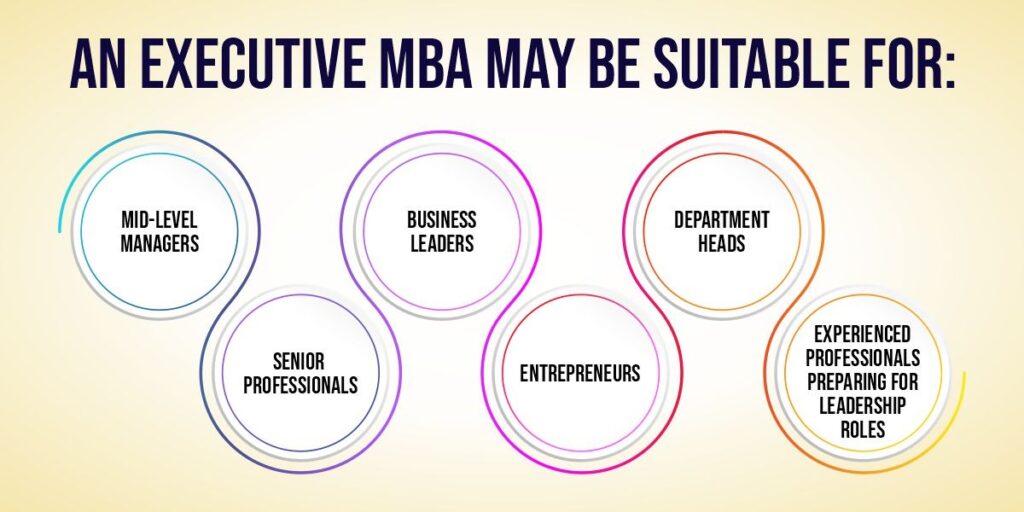
- Mid-Level Managers
- Senior Professionals
- Business Leaders
- Entrepreneurs
- Department Heads
- Experienced Professionals Preparing for Leadership Roles
An EMBA program helps working professionals strengthen their strategic thinking power and management capabilities: course recipients can continue their job and learn the MBA program simultaneously. For many working professionals, earning while learning mode is the most significant advantage.
It important to compareMBA vs Executive MBA to understand both the programs uniqueness.
Key Takeaways: MBA vs EMBA
| 1. MBA programs promote different career stages including entry to mid-career progress. But EMBAs is the best suitable for experienced professionals. |
| 2. Full-time MBA students often pause their professional careers, while EMBA students generally continue working. |
| 3. MBA programs offer electives and career-switching opportunities. At the same time, EMBAs keep focus on leadership ability grooming and peer learning. |
| 4. If you compare Executive MBA vs MBA, cost, schedule, experience, and career goals can help finding which program is the better fit. |
MBA vs Executive MBA: Difference Between MBA and Executive MBA
The most significant difference between an MBA and an Executive MBA is the target audience.
A traditional MBA is generally designed for learners who are building their management careers.
Executive MBA vs MBA: An Executive MBA is designed for professionals who already have achieved considerable workplace experience and want to move towards senior leadership roles in their professional career. Here is a simple MBA vs Executive MBA comparison:
| Parameters | MBA | EMBA |
| Target Audience | Students and Early-Career Professionals are the recipients | Experienced Working Professionals |
| Work Experience | Often minimum or notat all Required | Significant Professional Experience |
| Career Focus | Building a solidManagement Knowledge | Developing Leadership and Strategic Skill based acumens |
| Learning Approach | Academic & Practical | Experience-Based and Strategic, research based |
| Networking | Students And Young Professionals | Senior Managers and Experienced Executives |
| Career Stage | Early to Mid-Career | Mid To Senior Career |
| Target Audience | Students and Early-Career Professionals | Based On Concepts and Professional Experience |
If you comprehend these differences in MBA vs Executive MBA, it can help you or any other MBA pursuantto choose a program that matchcustomized professional journey. Read further to stop getting confused aboutMBA or Executive MBA program.
1. MBA vs Executive MBA:Work Experience Requirements
Professional Work experience is a leading factor that creates one of the significant differences between an MBA and an Executive MBA.
A traditional MBA can be suitable for fresh graduates and professionals with limited work experience. Some MBA programs may prefer candidates with professional exposure, but the requirements are generally more flexible.
An Executive MBA (EMBA) program is suitable for working professionals with adequate experience. For example, an Executive MBA classroom may include professionals from different industries like Information technology, Banking and Finance, Manufacturing, Healthcare, Marketing, Human resources, etc.
The knowledge about the difference between MBA and Executive MBA can improve the learning experience besides program selection. Professionals can understand how different industries approach similar business problems.
Why Experience Matters in an Executive MBA
Professional experience helps participants contribute more effectively during discussions.
They can analyse topics based on real situations.For example, a discussion about leadership may include experiences related to:
- Managing large teams
- Handling workplace conflicts
- Leading organisational change
- Improving business performance
- Making strategic decisions
This practical work exposure offers the Executive MBA programs a different learning structure.
2. Career Goals and Professional Outcomes
A Traditional MBA
If we compare MBA vs Executive MBA, an MBA and an Executive MBA support different career objectives, respectively. Individuals who want to start or accelerate their management careers often go for traditional MBA and it is a . It can help professionals move into areas like:
- Marketing management
- Financial management
- Human resource management
- Operations management
- Business development
- Management Consultancy
- Project management
A traditional MBA can also support a career transition. For example, an IT professional may pursue an MBA to move into business management niche in his professional career.
An Executive MBA
An Executive MBA lays its focus on career advancement for senior professionals at professional level. It is often an online MBA option.
Participants may aim for roles such as:
- Senior Manager
- Business Unit Head
- Director
- General Manager
- Entrepreneur
- Senior Executives
The program can promote experienced professionals with a developed and broader understanding of business. This quality is important for leadership positions.
In the comparison between MBA vs Executive MBA , career goals is an important point learners should consider before selecting their course.
Read Also:- Top MBA Specializations for Future Leaders: Boost Career
3. MBA vs Executive MBA: Course Content and Learning Focus
Both the MBA programs cover important business subjects. However, the depth and focus of these two programs may differ if we set a comparison between MBA vs EMBA.
A traditional MBA deals with fundamental management concepts. Students develop knowledge across major business functions. Common subjects may include:
- Principles of Management Theories
- Marketing Management
- Financial Management
- Business Economics
- Organisational Behaviour
- Operational Management
- Business Strategy and strategic planning
- Business Analytics and research on the data gained
The EMBA program assists learners build a strong management foundation. An Executive MBA puts greater emphasis on strategic and leadership issues. The focus of this program is often on applying knowledge to complex business challenges.
4. Learning Style and Classroom Experience
If we compare MBA vs Executive MBA, we will find that the learning style can also be markedly different. MBA students often learn through a combination of theory and practical activities. These may include:
- Case Studies & Group projects
- Professional Presentations of theories and business applications
- Business simulations
- Research assignments
The objective is to help learners understand and apply business concepts.
Executive MBA program mostly uses an experience-driven learning model. Participants can connect academic concepts with their workplace experiences. Classroom discussions may involve real challenges such as:
- Managing Organisational Changes
- Practices That Can Improve Business Efficiency
- Developing Growth Strategies
- Leading Diverse Teams
- Managing Market Competition
This makes peer learning an important part of the Executive MBA experience. Professionals learn not only from faculty members but also from other experienced participants.
5. The Right MBA program must OfferFlexibility for Working Professionals
In contrast to traditional MBA, EMBA programs are often designed to offer support for working professionals. Depending on the institution and program format, learning may be offered through flexible schedules.
These are mostly online MBSs and the programs are planned in a way that can help working professionals to study while maintaining a smooth work-life balance. Flexible learning formats can offer several benefits, some of which are
- Improved Work-Study Balance
- Integration of learning and working Professional Experience
- Immediate Application of Knowledge in real life
- Career Continuity and uninterrupted earning and scope of earning professional rewards
- Reduced Disruption to Professional Life
For working professionals, flexibility is an important advantage. They do not have to disconnect from their careers entirely while pursuing management education.
Read Also:- MBA in Project Management: A Smart Career Investment
6. MBA vs Executive MBA: Salary and Career Growth Expectations
Many candidates compare MBA and Executive MBA programs based on salary expectations. However, salary growth depends on multiple factors.These factors include:
- Industry Or Niche
- Work Experience &Professional Skills
- Job Performance
- Location And Organisation
- Market Demand
A traditional MBA can help early-career professionals to access better management opportunities. It may support faster career progression.

An Executive MBA may help experienced professionals prepare for roles with greater responsibility. However, a degree alone does not guarantee a promotion or salary increase.
The worth of management education largely depends on the application of the learning skill of professionals. The best results is the integration of education with the following acumens:
- Leadership Ability
- Industry Knowledge
- Communication Skills
- Strategic Thinking
- Professional Experience
Therefore, candidates should focus on long-term career value rather than only immediate salary outcomes.
7. MBA vs Executive MBA:Time Commitment and Program Structure
Time commitment is a point of concern for MBA pursuant. Before selecting an MBA program, candidates should carefully consider their available time.
A traditional MBA can require significant academic commitment.Students may need time for:
- Classes
- Assignments
- Projects
- Examinations
- Internships
- Group activities
An Executive MBA is often designed differently because participants may already have demanding professional responsibilities.However, this does not mean the programme is easy.Experienced professionals must manage work, studies, and personal responsibilities.
Before joining an MBA program, professionals should consider:
- Their weekly work schedule
- Family responsibilities
- Career goals
- Ability to manage assignments
- Preferred learning format
Choosing the right format can make the learning journey more productive.
Read Also:- MBA in the AI Era: Prepare for Tomorrow’s Jobs
MBA or Executive MBA:How to Choose Between an MBA and an Executive MBA
The right program depends on your current career position.Ask yourself a few important questions.
Choose an MBA if:
- You have just started your professional career or in the mid-career segment
- You have limited work experience.
- You want to build fundamental management knowledge.
- You are planning a career change.
- You want to explore different business functions.
- You are preparing for your first management role.
Join an Executive MBA program, if:
- You already have earnedsignificant professional experience. Now looking for an upgradation.
- You are working in a managerial position. You are planning ti
- You wish to move into senior leadership.
- You want to improve strategic decision-making power.
- You want to learn while earning.
- You want to expand your professional network.
The buzzword is to select an MBA program based on your career needs rather than its name alone.An MBA program should support your next professional step.
Conclusion
A comparison between an MBA and an Executive MBA is not just about choosing the better program. In a nutshell, both have different purposes.
A traditional MBA is an excellent choice for students and early-career professionals who wish to build management knowledge and explore new career opportunities.
An Executive MBA (EMBA) is an ideal advanced level study program for experienced professionals who want to advance and develop their leadership skills to get prepared for higher-level responsibilities.
However, don’tmake the decision in a jiffy. At first you should evaluate your work experience, career goals, available time, and learning needs. A Management educational program can become a valuable investment when it aligns with your professional journey.
It’s Action Time: Count on IIBM for Next Professional Step
Ar you looking for strengthening your management knowledge? are you keen to prepare for the next stage of your professional career? IIBM Institute of Business Management can help you explore online MBA programs exclusively designed for working professionals. Consult IIBM today for free career assistance.
Explore IIBM program and take a strategic step towards stronger management skills, greater professional confidence, and long-term career growth.
FAQs
1. An MBA or an Executive MBA: Which MBA program is a better option for your career growth?
An MBA or an Executive MBA? The better option is a customized choice. as the choice should depend on your work experience, career goals, and current position. MBA suits beginners, while an Executive MBA is ideal for experienced professionals.
2. Who is the right candidate to pursue an MBA program?
Fresh graduates and early-career professionals are the ideal candidates to pursue an MBA to develop business knowledge and management skills. An MBA degree improves a candidate's career opportunities across different industries.
3. Is it true that Executive MBA Learners need to have professional work experience?
Yes, It is true. Most Executive MBA (EMBA) programs prefer candidates with a range of professional experience, as the course draws on workplace knowledge and leadership experience throughout the program.