
Before we delve deep into the topic of DBA vs MBA, let’s know in a nutshell about MBA and DBA respectively. An MBA is a qualification that stands for Master of Business Administration. A DBA is the acronym for Doctor of Business Administration.
An MBA is a master’s degree program that focuses on mastery of business management and leadership skills. On the contrary, a DBA degree is the short form of the course, Doctor of Business Administration. It is a research-focused advanced management qualification suitable for seasoned professionals aspiring to lead a business, provide consultancy for business solutions, or teach.
DBA vs MBA: Who Should Select Which Degree?
An MBA Degree
You need to choose an MBA degree for your next study module if you wish to pursue a management role. An MBA qualification suits professionals who want to build or accelerate their management careers. Most MBA or Master of Business Administration programs set eligibility requirements for applicants with a few years of work experience and a graduate degree.
An MBA degree is ideal for:
- Early-career management professionals
- Mid-level managers, aspiring for promotion and recognition
- Ambitious Team leaders
- Entrepreneurs and Business owners
- Career changers, looking for a better flight in their career.
An MBA suits professionals who want to build or accelerate their management careers. Professionals choose an MBA for the following gains.
- It increases management knowledge
- Shows Improvement in leadership abilities
- Helps switch between industries for better career exposure
- Increases promotion opportunities
- Boosts business confidence
An MBA or Master of Business Administration program develops versatile business skills that the candidate can apply across industries.
Read More:- MBA in Digital Transformation: Master Digital Leadership
A DBA Degree
A DBA is the right professional course for you if you are a master’s degree holder, have earned 10+ years of professional experience, and wish to invest expertise in research to become an industry specialist. A DBA degree is perfect for senior professionals. The study program suits the following working professionals:
- Senior executives
- Directors and Consultants
- Entrepreneurs and Business strategists
- Academic professionals interested in applied research
Beyond preparing students for management roles, a DBA degree strengthens executive leadership. Under this professional study course, Students investigate real business challenges within their industries. The result of their research improves the following factors:
- Organisational performance
- Business strategy, which is customized and ROI-centric.
- Leadership practices
- Increased acumen for Innovation
- Accelerated Operational efficiency
A DBA helps professionals become recognised thought leaders. If you compare between DBA vs MBA, both are stalwart in their respective domains. Lt’s see the purpose of the advanced study of MBA and DBA, respectively.
DBA vs MBA: Understanding the Purpose of a DBA and an MBA
Although both are business degrees, they differ in their scope. An MBA prepares professionals for management and leadership positions. But A DBA degree is a doctoral qualification for experienced professionals.
(A) An MBA degree keeps its focus on the following factors:
- Business management
- Marketing
- Finance
- Operations
- Human resource management
- Strategy
(B) A DBA degree is a doctoral qualification for experienced professionals.
It supports executives to do the following activities:
- Conduct applied business research
- Solve complex organizational problems
- Develop strategic leadership skills
- Influence business policy
- Drive innovation
MBA students learn practical business concepts through case studies, projects, and teamwork. Instead of learning basic management concepts, DBA students create practical business solutions using research.
DBA vs MBA Comparison: Key Differences
If you want to compare between an MBA and DBA, you need to learn betweenDBA vs MBA. If you Understand the differences by studying DBA vs MBA comparison, it makes theselection easier. We have divided the discussion in five parameters or scales. These are Program level, learning focus, career stage, research component, and career outcome.
| DIFFERENCE | MBA | DBA |
| Program Level |
|
|
| Learning Focus |
|
|
| Career Stage | Best for professionals willing o advance their management careers. | Best for experienced leaders who are looking for executive growth in their career. |
| Research Component | MBA or Master of Business Administrationprograms include projects and business case studies. | DBA programs involve extensive research and a doctoral thesis focused on solving business issues. |
| Career Outcome | MBA graduates often become:
|
DBA graduates often get promoted to:
|
Career Opportunities After an MBA or DBA is Done
Both the degrees improve career prospects.However, the opportunities differ. Let’s Take a closer look with DBA vs MBA comparison.
Career Opportunities with an MBA

An MBA opens doors in various industries.Many professionals also use an MBA to launch their own businesses. Other than Common roles include:
- Marketing Manager
- Operations Manager
- HR Manager
- Financial Manager
- Business Development Manager
- Product Manager
- Supply Chain Manager
- Project Manager
Career Opportunities with a DBA
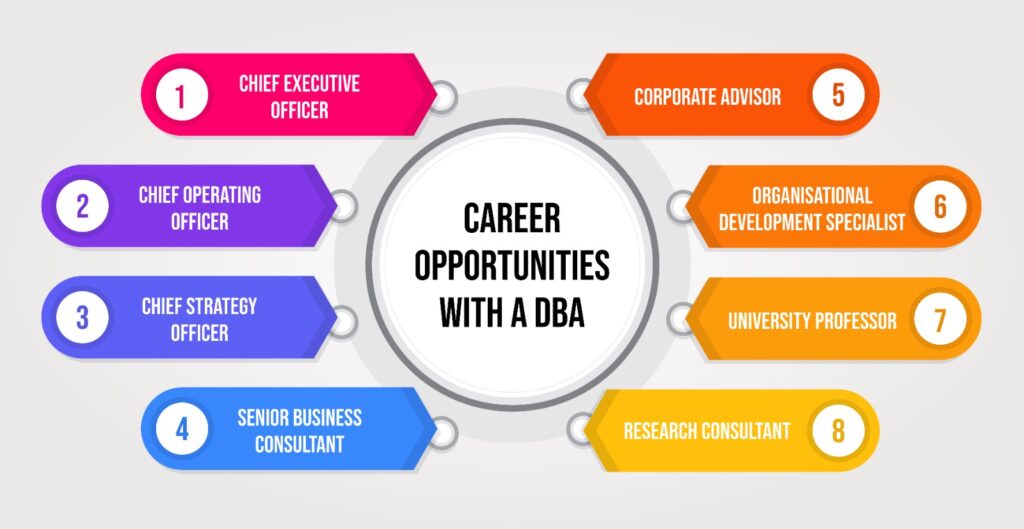
A DBA prepares professionals for higher-level leadership.Graduates often work as:
- Chief Executive Officer
- Chief Operating Officer
- Chief Strategy Officer
- Senior Business Consultant
- Corporate Advisor
- Organisational Development Specialist
- University Professor
- Research Consultant
A DBA also increases opportunities for board-level leadership.
Raed More:- DBA Graduate Skills: Why Employers Value Doctoral Talent
Professional Skills You Gain from Each Degree after Due Completion
Let’s compare DBAvs MBA for professional success. Both qualifications improve professional capabilities, which can accelerate professional accomplishment.Their learning outcomes differ.
MBA Skills helps in developing the following qualities:
- Business planning and development
- Financial management and related planning
- Marketing strategy and arrangement
- Leadership Acumen
- Professional Communication
- Team management and efficient Project management
- Decision-making ability for the sake of business development and ROI.
These skills support day-to-day business management.
DBA Skills for the program recipients help in strengthening
- Strategic thinking and customized solution
- Applied research based on data analytics
- Business analytics for business Development and planning
- Innovation management &Organisational leadership
- Policy development with Critical market analysis
- Executive decision-making
These skills help leaders solve complex business problems.
Which Degree Supports Long-Term Career Growth?
The potential of career growth depends on your current career stage, age, interest in professional domain, and professional goal. However, DBA vs MBA comparison chart will make it simple. Let’s discuss it part by part.
Choose an MBA degree to pursue if you:
- Want faster career progression
- Need management skills
- Plan to move into leadership
- Want broader business knowledge
- Are building your executive career
Choose a DBA course if you:
- Already hold senior management responsibilities
- Want to become a business expert
- Enjoy research-based problem-solving
- Aim for executive leadership
- Plan to teach or consult professionally

However, there are instances, when professionals complete an MBA first. And after that they may go for a DBAdegree after gaining substantial leadership experience and knowledge boost. The DBA degree pathway combines management expertise with advanced research capability that equips a professional with dynamic leadership abilities. Both qualifications remain highly respected worldwide.The most suitable degree or career path choice depends on your professional goals.
Conclusion
If we compare DBA vs MBA, both the degrees offer opportunities for career advancement. Both DBA and MBA address different professional needs.
An MBA degree trains capable managers who understand every aspect of business operations. A DBA degree shapes experienced business leaders who influence strategy, innovation, and organizational success through applied research.
It’s time to make your decision. You need to evaluate your experience, career objectives, and future ambitions. The academic and professional qualification should be supportive where you wish to be five or ten years from now.
It is important to invest in the appropriate executive degree can strengthen your expertise, expand your leadership potential, and create lasting career opportunities.
Advance Your Executive Career with IIBM
At IIBM Institute of Business Management, professionals can choose globally recognized Online MBA and Online DBA programs designed for today’s business environment. You can compare DBA vs. MBA in terms of flexible learning, experienced faculty, an industry-focused curriculum, and international academic partnerships that make it easier to study without interrupting your career and gain real-world experience.
Suppose you want to become a successful manager. Here an MBA will help, where IIBM can help you with the comfortable option of Online MBA. If you want to be a strategic business leader through a DBA, IIBM provides the knowledge and flexibility to help you achieve your professional goals. Here you can pursue DBA online from reputed foreign universities.
Now when you are well aware about the DBA vs MBA comparison, take the next step today and invest in a qualification that supports long-term career growth.
FAQs
1. What is the Main Difference Between A DBA and anMBA?
An MBA develops business management and leadership skills for professionals to perform operational roles in a business or in an organization. A DBA program focuses on applied research, strategic decision-making, and solving complex business challenges for senior leadership to advance the leadership abilities of DBA-qualified professionals.
2. Which Degree Is Better for Experienced Professionals, DBA Or MBA?
There is no cut-and-dried discrimination. Experienced professionals usually benefit more from a DBA degree because it strengthens research, leadership, and strategic thinking. An MBA degree suits professionals who want broader management knowledge and are planning for career advancement.
3. Does a DBA Degree Offer Better Career Opportunities than an MBA?
No, it is a misconception. A DBA degree opens opportunities in domains like executive leadership, consulting, academia, and research-driven roles. An MBA degree supports careers in management, operations, marketing, finance, and business development.
4. Who Should Select an MBA Course Instead of A DBA Course For Advanced Study?
Professionals starting or advancing management careers should choose an MBA Degree for their professional study. It builds practical business knowledge, leadership skills, and industry expertise without requiring extensive research experience.
5. Which Degree Provides Better Long-Term Career Growth, DBA Or MBA?
Both degrees offer excellent career growth potential. An MBA degree accelerates management careers, while a DBA prepares learner professionals for executive leadership, consulting, business research, and long-term strategic decision-making.