
Table of Contents
PhD research topic is an important part of the PhD Research process or a doctoral study, no matter if it’s business research or an academic doctoral program. A strong research idea gives direction to the entire research process. It shapes the research questions, methodology, data collection, analysis, and final contribution. However, here we will keep our discussion on a business PhD research topic.
There are at least 4 negative outputs if the PhD research topic idea is not properly researched. These are:
- The topic may become too broad or too expansive.
- Related data may turn inaccessible and incompatible with analysis
- The research gap may not be detectable.
- The research may not bring a meaningful contribution.
The scale of global research also shows why PhD research topic selection matters. UNESCO reported that the global number of researchers increased from 1,141 per million people in 2015 to 1,486 in 2023. Global R&D spending also increased from 1.71% of GDP in 2015 to 1.92% in 2023.
This growth means doctoral researchers are entering an increasingly active research environment. Selecting a focused and useful research idea can help your work stand apart.
But how to choose a PhD research topic?Here are eight real-life tips that can help an aspirant select a strong PhD research topic.
Selection of a research topic: Start with a Problem
A good PhD research topic should begin with a problem. Do not start with a broad subject alone. Start by identifying something that needs deeper investigation.
For example, “Digital Transformation in Business” is too broad. It covers many industries, technologies, and several management issues.
A better approach is to identify a specific problem in your PhD research topic. You could study how digital transformation affects decision-making among small businesses. According to PhD research guide, it gives the research a clearer direction.
A research problem should explain what is not working, not fully understood, or adequately studied. You may consider the following queries to establish the appropriateness of the topic.
- What problem needs further investigation?
- Who is affected by the problem?
- Why does the problem matter?
- What evidence already exists?
- What remains unanswered?
- Can the problem be studied with available resources?
Now you have a basic need about how to choose a PhD research topic. A strong problem statement can become the foundation of your entire research proposal.It can also prevent unnecessary expansion of the research scope.
How to Identify a Comprehensive Research Gap?
PhD research should contribute something meaningful to existing knowledge. Therefore, identifying a research gap is essential.A gap in Research topic for PhD refers to an area where existing studies do not provide sufficient answers. The gap may involve a theory, population, location, industry, method, dataset, or relationship between variables.
It is not recommended topresume that PhD research ideasare suitable simply because a few articles already exist. A lack of research can sometimes indicate that the PhD research topic is difficult to investigate.Instead, examine existing literature carefully. A candidate should check the following points:
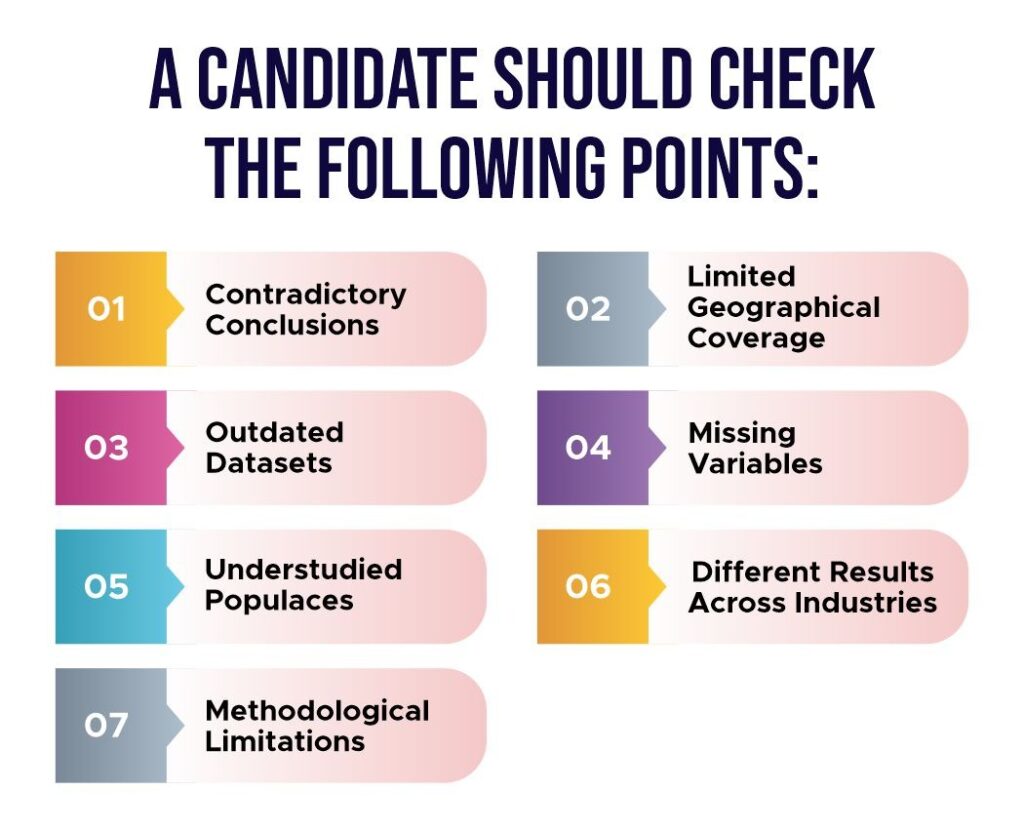
- Contradictory conclusions.
- Limited geographical coverage.
- Outdated datasets.
- Missing variables.
- Understudied populaces.
- Different results across industries.
- Methodological limitations.
Recent research methodology also highlights the importance of rigorous and reproducible research. A 2025 Nature study examined 600 papers in the social and behavioural sciences. Out of it, only 24% made data available for reproducibility assessment, while 53.6% of the assessed papers were rated as precisely reproducible.
This finding offers an important lesson. A research idea should not only sound interesting. It should also support transparent and reliable research practice trails.
How to Choose a Topic that Matches Interest and Expertise?
A PhD process can take several years to complete. You will spend considerable time reading, analysing, writing, revising, and discussing the subject. Therefore, personal interest matters. However, interest alone should not determine your topic. Your academic background and professional experience should also be considered.
Let’s count on an example. If you have experience in finance, you will mostly find topics on financial technology interesting. You may explore topics or PhD research ideas related to digital payments, financial inclusion, risk management, or technology-driven financial decision-making. Your existing knowledge can make the research process easier.
It is always wise to consider a few personal facts. Here are some essential points mentioned for ready reference:
- Academic background.
- Professional experience.
- Technical skills.
- Subject knowledge.
- Research interests.
- Industry exposure.
- Existing professional network.
A PhD research topic that connects most of these areas may give you a practical advantage. It can also make it easier to understand existing literature and identify meaningful research questions.
Why is it important to Check the Availability of Data and Resources?
An attractive research idea can fail if suitable data is unavailable. This is one of the most important checks before finalizing a PhD research topic. For example, you may want to study employee behaviour across 500 organizations. But access to such organizations may not be realistic. Similarly, a study may require confidential corporate data. Companies may not agree to share it.
Before selecting the final PhD research topic, assess your research resources. It is done easily by checking:
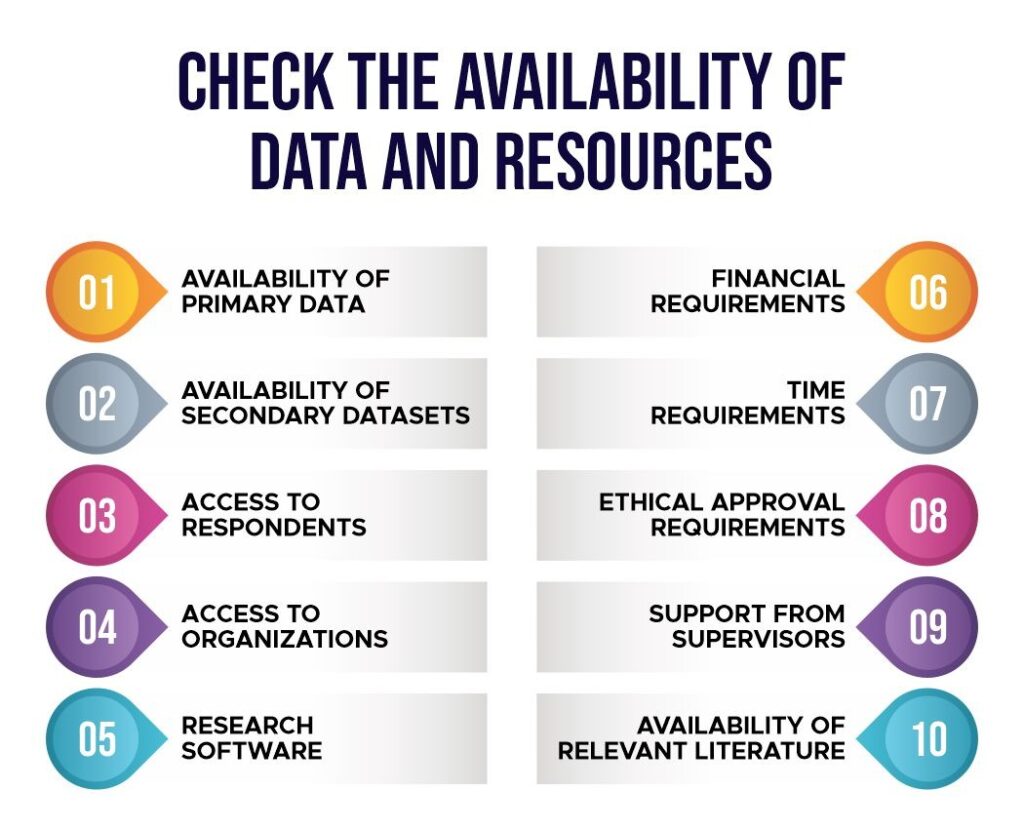
- Availability of primary data.
- Availability of secondary datasets.
- Access to respondents.
- Access to organizations.
- Research software.
- Financial requirements.
- Time requirements.
- Ethical approval requirements.
- Support from supervisors.
- Availability of relevant literature.
Research activity is expanding globally. UNESCO’s 2026 data release has reported 1,486 researchers per million inhabitants worldwide in 2023. However, a competitive PhD research topic should match the resources realistically available to you.
Read Also:– Most Demanding Courses in 2026: Build a Future-Ready Career
Why we should Make the Research Topic Specific and Manageable?
Many doctoral researchers make one common mistake. They choose a topic that is too broad. A PhD is not expected to solve an entire field’s problems.It should investigate a specific research question in sufficient depth.For example,
| Too broad:“Artificial Intelligence and Business Management” More focused:“Impact of Generative AI on Managerial Decision-Making in Indian SMEs” |
- The first topic or the related PhD research ideas is broad, so you cannot focus on a specific genre.
- The second topic identifies a technology, outcome, population, and geographical context. It is more focused than the first option.
A focused topic helps you control the research scope. Also, it is possible to narrow the PhD research topic by defining the following genres:
- Industry.
- Geography.
- Population.
- Age group.
- Organization size.
- Technology.
- Time period.
- Key variables.
- Research methodology.
A manageable topic also makes data collection easier. It helps you develop clearer research objectives. It can also make your methodology more precise. Remember that a smaller research question can still produce an important contribution.
Read More:- Earning a Degree While Working Full-Time: Study Smart
How to Evaluate the Originality and Research Value?
Originality is a major consideration when selecting a PhD research idea.Your topic should offer something beyond simply repeating an existing study.However, originality does not always mean discovering something completely new.

You can create originality by applying an existing theory to a new context. You can also use a different methodology or PhD research guide.Possible forms of originality include:
- Applying an existing theory to a new industry.
- Studying an under-researched population.
- Comparing two previously unexplored markets.
- Testing an established model in a new environment.
- Using a new dataset.
- Developing a new conceptual framework.
- Challenging an existing assumption.
- Combining established theories in a new way.
Research quality is also closely linked to reproducibility. A large 2026 Nature study attempted to replicate 274 claims from 164 quantitative papers. Only 55.1% of the claims produced statistically significant results in the same direction as the original findings.
The result reinforces an important point. A strong research idea needs more than novelty. It needs methodological strength and a research design that can produce dependable evidence.
Why to Assess the Practical and Academic Impact of the PhD Research topic?
A strong PhD Research topic should have a clear reason for being studied. Ask yourself what the research could change. The answer may have academic value. It may help develop a theory or address an existing debate.
Research topic for PhD may also have practical value. The findings could help businesses, policymakers, educators, healthcare organizations, or other stakeholders make better decisions.
Consider both dimensions, such as academic values and practical values. Let’s dive into the points.
Academic value may include:
- Extending existing knowledge.
- Testing an established theory.
- Developing a conceptual model.
- Addressing a literature gap.
- Creating new research questions.
Practical values may include:
- Improving organizational decisions.
- Supporting policy development.
- Reducing business risks.
- Improving employee practices.
- Enhancing customer experiences.
- Supporting technological adoption.
The wider research environment demonstrates the importance of applied research. UNESCO reported that global R&D expenditure reached 1.92% of global GDP in 2023, up from 1.71% in 2015. Yet 73% of countries still invested less than 1% of GDP in R&D.
This investment reflects the growing importance of research for innovation and development. PhD research should therefore have a clearly stated contribution. Explain who can use the findings and how.
Read More:- Online Degrees in 2026: Advance Your Career Online
How to Validate the Research topic Idea Before Finalising It?
Do not finalise your PhD research topic after one search.Test the idea first. You may Discuss it with your potential supervisor or academic experts. Search recent journal articles. Review dissertations. Examine conference papers. Look at current debates in your field.
Alternatively, the researchermay prepare a preliminary research framework or the path to follow the PhD research ideas. In this course, it is essential to write down the following points:
- The proposed research problem.
- The research gap.
- The main research question.
- Possible objectives.
- Target population.
- Potential methodology.
- Data sources.
- Expected contribution.
- Possible limitations.
You should also check whether your research question can actually be answered. A question that is interesting but impossible to measure may not make a suitable doctoral topic.
Research reliability should also be considered at this stage. A 2018 replication study of 21 social-science studies published in Nature and Science found significant results in the same direction for 13 studies, or 62%. The replicated effect sizes were also about 50% of the original effect sizes on average.
This data demonstrates why research design matters from the beginning. A well-defined research question makes it easier to select an appropriate methodology and produce credible findings.
Conclusion
Suppose you want to select the right PhD research topic. The process is more than choosing an interesting subject. It is involved with careful evaluation. A strong research idea should address a genuine problem. It should have a clear research gap. It should match your knowledge and interests. It should also be feasible.
Data must be accessible. The scope must be manageable. The methodology must be appropriate. The research should offer academic or practical value. Start with a clearly defined research problem.
The growth of global research makes thoughtful topic selection even more important. With researchers and R&D investment increasing worldwide, doctoral scholars have opportunities to address important problems across business, technology, management, education, and other disciplines.
Start Your Doctoral Research Journey With IIBM
The process of selecting a PhD research topic can be challenging. A structured academic environment can help you to follow research methodology, develop research questions, evaluate literature, and build a stronger research proposal.
IIBM can support aspiring doctoral researchers who want to develop advanced research capabilities alongside their professional goals. Explore the available doctoral learning opportunities and understand how a structured research-focused programme can support your academic and professional journey.
Start with the right research idea. Build it into meaningful research. Take the next step towards your doctoral goals with IIBM.
FAQs
1. How do I choose a PhD research topic?
Start with subjects that interest you. Read recent studies, identify unanswered questions, and select a topic that offers scope for meaningful academic research.
2. What makes a good PhD research topic?
A good topic should be specific, relevant, researchable, and original. It should address a genuine gap and contribute something useful to existing knowledge.
3. How do I find research gaps?
Read recent journals, dissertations, and research papers. Look for limitations, unanswered questions, conflicting findings, and areas suggested for further research.
4. May I choose a topic from my work experience?
Yes, it is possible. Professional experience can help you identify practical problems, industry gaps, and useful research questions that deserve deeper academic investigation.
5. How to check the originality of my research Topic?
Search academic databases and recent publications. Compare existing studies with your proposed idea to understand whether your topic offers a genuinely different research perspective.