An MBA in Digital Transformation bridges the gap between traditional business management and emerging technologies that are data-driven, research-based, and intensely results-oriented. It is a digital business strategy that prepares leaders to navigate organizational change, process improvement, and tech-based innovation.
If we assess modern market trends, key subjects of Digital Transformation include Artificial Intelligence (AI)/ Machine Learning (ML) integration, data analytics, digital business strategy, and change management. Businesses invest in technology to improve operations, customer experience, and decision-making. However, technology alone cannot drive success. Organizations also need skilled leaders who understand strategy, innovation, and digital transformation. A professional with an MBA in Digital Transformation qualification is the right choice for bringing in the desired change in an organization, with the ability to read analytics, automation, innovation, and strategic planning.
It is a proven hypothesis that digital leadership skills can support your career towards growth. Let us explore how an MBA in Digital Transformation can assist a professional in mastering the future of a business.
Input of an MBA In Digital Transformation – A Short Overview
An MBA in Digital Transformation is not only a managerial qualification; it is a trend setting step for better future of a business. The transformation keeps it focus on managing business growth through digital technologies and innovation. The learners gain professional insight into how technology changes business models, customer engagement, and organizational performance.
Unlike a traditional MBA, this specialized professional study program emphasizes on digital business strategies and technology-driven leadership to open wonderful breakthrough in Digital transformation careers. Students usually learn:
- Digital business strategy
- Artificial Intelligence applications
- Data analytics for business growth
- Cloud computing fundamentals for its uses
- Cybersecurity management for better data safety
- Innovation management and relatedchanges acceptance.
- Digital marketing strategies
The course syllabus combines management principles with practical digital skills. Students develop the confidence to lead transformation projects across organizations as a one of the most challenging part of their digital transformation careers.
Read More:- Online MBA Program: Is It Truly Worth the Cost in 2026
How to scale the requirement of Digital Transformation of business workflow?
Digital transformation of a business workflow requires a structured approach. Business leaders should keep people, processes, and technology in balance.
A clear roadmap of the transformation helps avoid confusion and reduces implementation risks. Every department should understand the transformation goals. Regular evaluation keeps the process aligned with business objectives.
- Assessment of the current workflow is a requisite to decide on Digital business strategy.
- It is equally important to identify repetitive tasks and operational bottlenecks.
- Besides prioritization of the areas that need immediate improvement is ultra important.
- It is necessary to train about the digital tools in phases instead of changing everything at once.
Key steps to scale digital transformation include:
- Define clear business objectives before adopting new technologies.
- Map existing workflows to identify improvement opportunities with Digital business strategy.
- Automate repetitive and time-consuming business processes.
- Adopt cloud-based platforms for better collaboration and flexibility.
- Integrate different business systems to ensure smooth data flow.
- Training of the employees to use new digital tools is a vital process.
- The leader should be able to monitor performance using measurable key performance indicators (KPIs).
- Customer and employee feedback for continuous improvements is always an asset.
Why does an MBA-qualified employee do the task better?
An MBA with keen knowledge of digital transformation can plan the entire process after intense research and study of relevant case studies. An MBA program develops the talent of strategic thinking, technology management skills, and change leadership capabilities. Graduates can confidently design scalable digital workflows, improve operational efficiency, and drive sustainable business growth in an increasingly digital economy as one of the premium MBA degree benefits.
Why Digital Leadership Matters for Today’s Business Growth?
Every organization may experience digital disruption at one point of time. For example, businesses may adopt automation, AI, cloud platforms, data-driven decision-making, etc.as the part of Digital business strategy.
These changes require capableleaders who understand both business and technology. Digital leaders help companies remain competitive. They contribute by:
- By inventing new business opportunities
- Leading initiatives that lead to digital transformation
- Improvement of operational efficiency
- Building innovation-focused teams
- Managing the instruction of technological change and its nuances
- Supporting customer-centric strategies
Digital leadership is no longer limited to technology companies. Other business domains like manufacturing, healthcare, education, banking, logistics, hospitality, and all government organizations require professionals with digital expertise, which MBA professionals can explore as the opening for their Digital transformation careers.
Employers now value leaders who can balance innovation with business goals. This task becomes easier with an MBA in Digital Transformation qualification. But how does it help? Let’s explore:
Skills You Develop from an MBA in Digital Transformation Program
The MBA in Digital Transformation program develops technical awareness along with managerial capabilities in students. Learners can improve their leadership skills while getting knowledge about how digital technologies influence business decisions, which is one of the exclusive MBA degree benefits.
Primary leadership skills include:
- Ability of Strategic thinking
- Digital decision-making power with data support
- Problem-solving skill with research
- Team management skills for increased output
- Business communication for seamless productivity in a tight timeframe.
- Critical analysis with the help of accumulated data.
- Innovation leadership and efficient Risk management
Technical knowledge includes:
- Business intelligence
- Artificial Intelligence basics
- Machine learning applications
- Cloud technologies and their customized applications
- Data visualization & Business automation
- Digital platforms with Emerging technologies
These future-ready skills prepare the MBA in Digital Transformation program-qualified employees to handle modern business challenges confidently, which helps their faster career progression.
Career Opportunities After an MBA in Digital Transformation
It is a proven fact that digital transformation has created leadership opportunities across industries. Organizations need trained professionals who understand technology and business equally well. The training program helps professionals progress in their careers, as the skills developed in the MBA in Digital Transformation program make their CVs more acceptable in the job market. Graduates can explore MBA career opportunities in potential roles like:
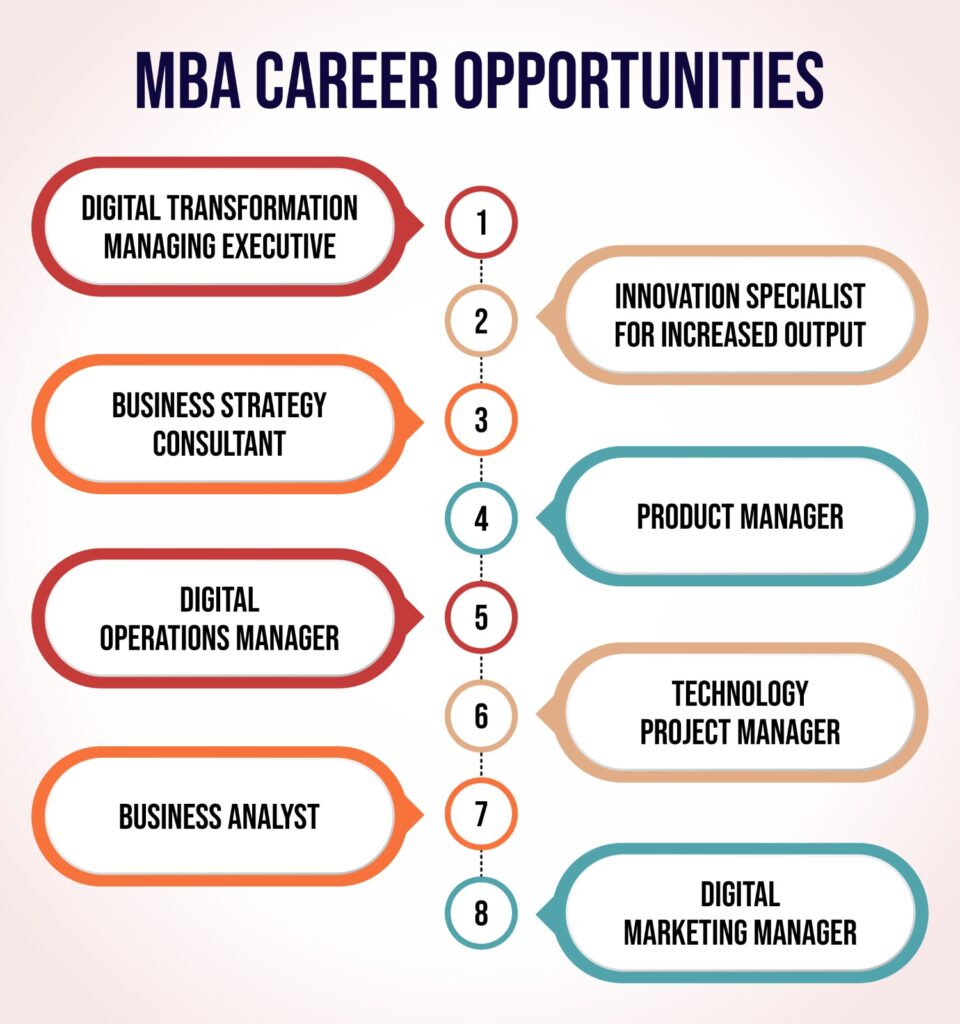
- Digital Transformation Managing Executive
- Innovation Specialist for increased output
- Business Strategy Consultant
- Product Manager
- Digital Operations Manager
- Technology Project Manager
- Business Analyst
- Digital Marketing Manager
Industries that often hire digital leaders and offer MBA career opportunities:
- Information Technology or IT Companies
- Banking and Financial Services (NBFC Segment)
- Healthcare
- Retail
- Manufacturing
- E-commerce
- Telecommunications
- Education
- Consulting
- Logistics
The growing digital economy continues to create demand for professionals with specialized management expertise, and it is one of the best MBA degree benefits.
Working Professionals are Ready for an MBA in Digital Transformation: Why?
The contemporary trend shows that ambitious professionals pursue higher education without leaving their current jobs. Online MBA programs offer flexibility while supporting career growth. The benefits include:

- Facility to continue earning while studying
- Flexible learning schedules for self-paced study
- Industry-relevant Syllabus
- Networking opportunities
- Career advancement
- Leadership development
- Better promotion prospects
Working professionals can directly apply classroom learning to real business situations. This improves both learning outcomes and workplace performance.
An online management study program also allows professionals from different industries to collaborate and exchange practical experiences as a part of their study with the facility of exploring MBA career opportunities.
Future Trends Driving Demand for Digital Leaders
Businesses nowadays prefer to invest in advanced technologies to improve output and reduce costs. These developments increase the demand for qualified digital transformation professionals. Emerging trends include:
- Artificial Intelligence integration to workflow
- Improved Business automation for smooth operation
- Cloud-first organizations
- Data-driven decision-making
- Digital customer experience
- Blockchain Applications for enhanced safety
- digital innovation for better sustainability.
Organizations prefer to hire business leaders who can evaluate these technologies and implement them strategically. Professionals with an MBA in Digital Transformation remain well-positioned to lead future business innovations.
How to Choose the Best MBA in Digital Transformation Program
Selecting the right institution plays an important role in career development. A quality MBA program combines academic excellence with industry relevance. Look for the programs offering the following benefits:
- Industry-focused curriculum for the latest insight
- Experienced faculty for mentoring
- Flexible online learning program for best study benefits.
- Practical case studies
- Leadership development
- Technology-focused learning
- Strong student support
Also consider whether the institution provides opportunities for networking, career guidance, and exposure to current business practices.
A well-designed MBA should prepare students for immediate workplace success and long-term leadership roles.
Conclusion
An MBA in Digital Transformation trains professionals with the trending knowledge and leadership skills. These skills are very much needed in today’s rapidly evolving business environment.
Digital technologies are in absolute forces to continue to reshape industries, customer expectations, and business operations. Organizations therefore seek leaders who can successfully manage innovation while delivering measurable business results in this dynamic business landscape.
This specialized MBA program combines strategic management with digital expertise. It makes graduates valuable assets across multiple industries.
No matter if your goal is career advancement, leadership development, or business innovation, this MBA qualification offers practical skills that remain relevant in the digital economy.
Investing in digital leadership today prepares you for tomorrow’s business challenges and opportunities.
Advance Your Career with IIBM Institute of Business Management
The IIBM Institute of Business Management offers flexible online management programs designed for ambitious working professionals. The online MBA helps learners develop future-ready leadership skills through an industry-oriented curriculum, experienced faculty, and practical business insights, which is a sheer advantage of digital transformation process.
With flexible online learning, scope of global exposure, and career-focused education, IIBM enables professionals to upgrade their qualifications without interrupting their careers.
If you are ready to lead digital innovation and accelerate your professional growth without leaving your current job, choose IIBM and take the next step towards becoming a confident digital business leader.
If you have any query about your career development, please comment below. We will be happy bto help you.
FAQs
1. What are the qualifications required for an MBA learner keen to learn Digital Transformation?
The qualification criteria may vary from one institution to another. Candidates usually need a bachelor's degree from a recognized university. Some institutions may also consider work experience or relevant professional qualifications when admitting candidates.
2. Is it possible for working professionals to apply for an online MBA to learn more about Digital Transformation
Yes. Many online and flexible MBA programs welcome working professionals. They can study while continuing full-time jobs and immediately apply new skills in their roles.
3. Does work experience help an MBA student learn the Digital Transformation Process?
Yes, it is an obvious advantage. Many universities accept fresh graduates without experience. However, professionals with industry experience often gain additional practical insights during the program. The nuances of digital transformation and its requirement for an organization is best felt by a working professional.
4. Can graduates from any discipline pursue an online MBA?
Yes. Graduates from engineering, commerce, arts, science, management, or other disciplines can pursue this MBA and build valuable digital business leadership skills.
5. Which skills are vital for an MBA-Qualified Student to excel in Digital Transformation Strategy for an organization?
Some vital skills include analytical thinking, communication, problem-solving, adaptability, leadership, teamwork, and technology awareness, which help students understand digital strategies and manage organizational transformation successfully.
6. Is an MBA suitable for fresh graduates to learn about Digital Transformation?
Yes. Fresh graduates can develop business, leadership, and digital management skills, improve employability and prepare for careers in technology-driven industries and organizations.